
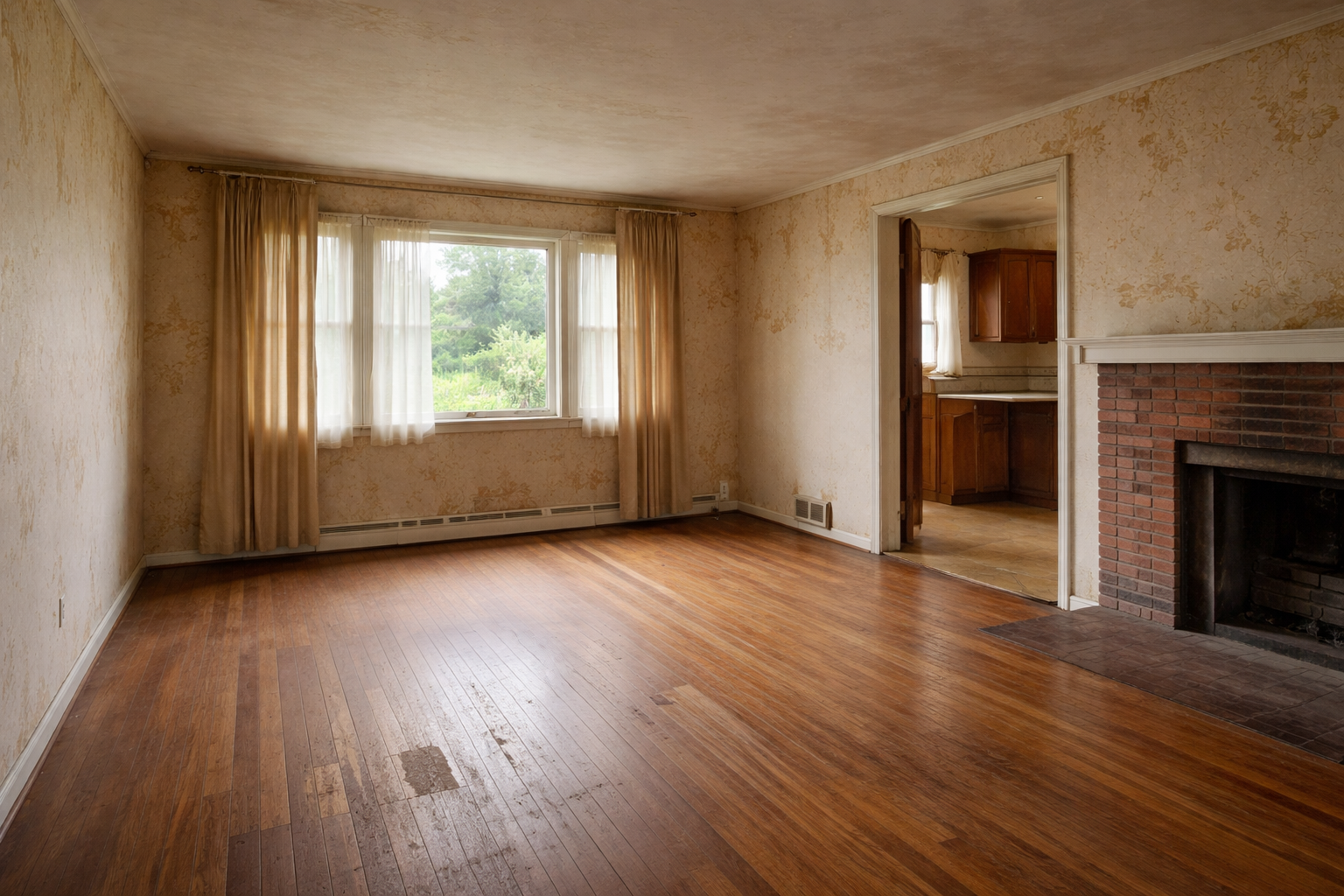
If you’re thinking about selling a house as-is on Long Island, you probably have one big question: what does “as-is” actually mean — and what are you giving up by going that route?
The short answer: selling as-is means the buyer agrees to purchase your property in its current condition. You don’t need to make any repairs, renovations, or improvements before the sale closes. Instead, the buyer accepts the home exactly as it stands.
But that simplicity comes with nuance — especially in New York, where disclosure laws changed significantly in 2024. What you can skip and what you’re still legally required to do are two very different things, and getting it wrong can expose you to liability even after closing.
This guide covers what selling as-is actually involves on Long Island, what New York law requires you to disclose, the real pros and cons, and how to compare your options so you can make the best financial decision for your situation. For a broader look at every fast-sale scenario, read our complete guide to selling your Long Island house fast.
What “As-Is” Actually Means in New York Real Estate
When you list or sell a property “as-is,” you’re telling the buyer: this is what you’re getting. The buyer takes on all repairs, and no credits will be given for defects. Instead, the price reflects the home’s current condition.
New York law explicitly allows as-is sales. Under Real Property Law §462(1), the statute states: “Nothing contained in this article or this disclosure statement is intended to prevent the parties to a contract of sale from entering into agreements of any kind or nature with respect to the physical condition of the property to be sold, including, but not limited to, agreements for the sale of real property ‘as is’.”
So selling as-is is completely legal. But — and this is the critical part — selling as-is does not exempt you from New York’s disclosure requirements.
New York’s Disclosure Law Changed in 2024 — Here’s What You Need to Know
This is where most as-is sellers get tripped up, because the rules changed significantly on March 20, 2024.
The Old Rule (Before March 20, 2024)
Under the original Property Condition Disclosure Act (PCDA), codified in Real Property Law §§460-467, sellers of residential property had to complete a Property Condition Disclosure Statement (PCDS) — a standardized form disclosing known defects to the buyer before signing a contract of sale.
However, there was a widely used workaround. Under the former §465(1), sellers who chose not to provide the PCDS could instead pay the buyer a $500 credit at closing. On Long Island and throughout the New York City metro area, this became standard practice. In fact, most sellers’ attorneys advised paying the $500 rather than completing the form, viewing it as less risky than potentially exposing their clients to claims based on misstatements in the disclosure.
The New Rule (Effective March 20, 2024)
Governor Hochul signed A1967/S5400 into law on September 22, 2023, and the changes took effect on March 20, 2024. The amendment made two significant changes:
First, the $500 credit option was eliminated. Sellers can no longer opt out of the PCDS by paying a credit. The amended §465 was renamed from “Remedy” to “Liability,” and the $500 credit provision was deleted entirely. As a result, sellers now must provide the disclosure statement.
Second, the PCDS expanded from 49 to 56 questions. Seven new questions address flood hazard areas — including whether the property is in a FEMA-designated 100-year or 500-year floodplain, federal flood insurance requirements, flood damage claims, and FEMA elevation certificates. On Long Island, where coastal flooding is a real concern in many South Shore and barrier beach communities, these questions are particularly relevant.
What This Means for As-Is Sellers
Even if you’re selling as-is, you must now complete the 56-question PCDS and provide it to the buyer before they sign a binding contract. The good news: the disclosure is based on your actual knowledge only. Under §462(3), nothing in the law requires you to undertake any investigation or inspection of your property or to check public records before completing the form.
You answer what you know, and if something is unknown, you simply mark it that way on the form. There’s no expectation to hire an inspector or research FEMA maps — though the buyer certainly should do their own due diligence.
However, a knowingly false or incomplete statement on the PCDS can now subject you to claims by the buyer both before and after the transfer of title. As the amended law states: “Nothing contained in this Article shall be construed as limiting any existing legal cause of action or remedy at law, in statute or in equity.” In practice, this language is intentionally broad and leaves the door open for various claims.
Bottom line: selling as-is is still legal and still a smart move in many situations — but you cannot skip the disclosure form. Therefore, work with a New York real estate attorney to complete the PCDS properly.
Caveat Emptor Still Applies — But It’s Not a Free Pass
New York has historically followed the doctrine of caveat emptor — “let the buyer beware.” Under this principle, the seller has no general duty to disclose property defects, and the buyer takes responsibility for their own inspections and due diligence.
The PCDA didn’t eliminate caveat emptor. Even now, the disclosure statement explicitly notes that it is not a warranty and is not a substitute for the buyer’s own inspections. Nevertheless, the courts have carved out important exceptions over the years:
Active concealment: If you know about a defect and actively take steps to hide it — for example, painting over water damage or putting furniture over a damaged floor — you can face liability regardless of any as-is clause. The as-is agreement and even a merger clause in the contract will not protect a seller from a fraud claim based on active concealment.
Affirmative misrepresentation: If you tell the buyer something about the property that you know is false — even verbally — that creates liability.
Partial disclosure: Similarly, if you reveal some issues but conceal others, creating a misleading picture of the property’s overall condition, that can also trigger liability.
The practical takeaway: be honest about what you know, complete the PCDS truthfully, and don’t try to hide anything. If you’re selling to a cash buyer who handles their own inspections and accepts the property in current condition, then the disclosure process is usually straightforward.
What Conditions Can You Sell As-Is?
There is no minimum condition requirement for selling a house. Cash home buyers on Long Island purchase properties in virtually any state — whether the home needs a full gut renovation, has foundation or structural problems, mold or water damage, fire damage, hoarding situations, code violations, or simply hasn’t been updated since the 1960s or 1970s.
On Long Island, older housing stock is common. Many homes in Suffolk County and Nassau County were built in the postwar housing boom of the 1940s through 1970s. Consequently, deferred maintenance is especially common in estate and probate situations, where a property may have sat neglected for years before hitting the market.
Common conditions we see in as-is sales on Long Island include:
- Roof damage or a roof that’s past its useful life
- Foundation cracks or structural settling
- Outdated electrical (knob-and-tube, fuse boxes)
- Old or failing plumbing (galvanized pipes, cesspool issues)
- Mold, water damage, or flooding history
- Fire or smoke damage
- Hoarding situations requiring extensive cleanout
- Open permits or code violations
- Asbestos, lead paint, or oil tank issues
- Properties with liens or title complications
A cash buyer’s offer price factors in the property’s current condition and the estimated cost of repairs — but the point is that no condition is a dealbreaker.
The Real Pros and Cons of Selling As-Is
Selling as-is isn’t the right move for everyone. Here’s an honest breakdown.
Advantages of Selling As-Is
Speed. You skip the weeks or months of repairs, contractor scheduling, and renovation headaches. A cash sale can close in as little as two to four weeks — sometimes faster. If you’re dealing with a divorce, foreclosure, or job relocation, then speed matters more than anything.
Cost savings. Renovation costs on Long Island are not cheap. For example, a new roof can run $15,000 to $30,000+. Foundation work starts at $10,000 and escalates quickly. Meanwhile, a full kitchen or bathroom renovation can easily hit $40,000 to $60,000. When you sell as-is, you’re not gambling tens of thousands of dollars on repairs that you may not fully recoup in the sale price.
Simplicity. There’s no staging, no open houses, and no parade of potential buyers through your home. You also avoid appraisal contingencies and financing contingencies that can fall through at the last minute. It comes down to one buyer, one offer, one closing.
Certainty. With a cash buyer, the deal doesn’t depend on a bank approving a mortgage or an appraiser hitting a certain number. The closing date is set and it holds. When you need predictability in an unpredictable situation, that certainty has real value.
Disadvantages to Consider
Lower sale price. This is the tradeoff. As a result, cash offers on Long Island typically range from 70% to 85% of the home’s after-repair market value, depending on the condition and scope of repairs needed. For instance, a home that would sell for $600,000 fully renovated through a traditional listing might draw a cash offer in the $420,000 to $510,000 range.
Limited buyer pool. Not all buyers can or will purchase a property that needs significant work. Traditional buyers who need a mortgage may not qualify for financing on a home with major structural, mechanical, or safety issues — lenders require certain conditions before approving a loan. This effectively narrows your buyer pool to cash buyers and investors.
Perception. Some buyers see “as-is” as a red flag and assume the home must have serious hidden problems. However, working with a cash buyer who specializes in as-is purchases eliminates this issue — they expect the condition and price accordingly.
The Real Math: As-Is Cash Sale vs. Traditional Listing
Before you assume you’re leaving money on the table by selling as-is, run the full comparison. In reality, most people focus only on the sale price and forget the costs that come off the top in a traditional sale.
Consider a Long Island home with an after-repair market value of $600,000 that needs approximately $50,000 in work to bring it to market-ready condition:
Traditional Sale:
- Sale price after repairs: $600,000
- Repair costs: -$50,000
- Agent commissions (5-6%): -$30,000 to -$36,000
- Closing costs (2-4%): -$12,000 to -$24,000
- Carrying costs during repairs + listing (3-6 months of taxes, insurance, utilities, mortgage): -$10,000 to -$25,000
- Staging and prep: -$3,000 to -$5,000
- Net proceeds: approximately $460,000 to $495,000
As-Is Cash Sale:
- Cash offer (75-80% of ARV): $450,000 to $480,000
- Agent commissions: $0
- Repair costs: $0
- Closing costs: $0 (buyer typically covers)
- Carrying costs: minimal (close in 2-4 weeks)
- Net proceeds: approximately $450,000 to $480,000
The net difference is often much smaller than people expect — and in some cases, the as-is cash sale actually puts more money in your pocket when you factor in the time value of receiving your proceeds months earlier, plus the elimination of the risk that a traditional sale falls through.
Do You Need a Lawyer to Sell As-Is in New York?
Yes. New York is an attorney state, meaning both the buyer and seller have their own attorneys at the real estate closing. This applies regardless of whether you’re selling through an agent, FSBO, or to a cash buyer.
A real estate attorney on Long Island typically charges $1,500 to $3,000 for a residential closing. Your attorney will review the contract of sale, handle the PCDS compliance, coordinate with the title company, and ensure your interests stay protected at closing.
Given the 2024 changes to the disclosure law, having an attorney guide you through the PCDS is particularly important. The form must be completed accurately, and the consequences of a knowingly false or incomplete statement can extend well beyond closing.
When Does Selling As-Is Make the Most Sense?
Selling as-is is typically the best financial and practical decision when:
- The property needs repairs you can’t afford or don’t want to manage
- You’re in a time-sensitive situation — divorce, foreclosure, relocation, or inherited property with mounting carrying costs
- You’re a tired landlord dealing with a problem rental property
- The property has code violations, open permits, or environmental issues that complicate a traditional sale
- You’ve inherited a home you’re not local to and can’t oversee renovations from a distance
- The cost-benefit analysis shows the net proceeds from an as-is sale are comparable to a traditional sale once you account for all expenses
How to Sell Your Long Island House As-Is for Cash
Step 1: Contact us. Tell us about your property and situation. We’ll ask about the address, condition, any liens or legal issues, and your ideal timeline. Call (516) 548-6558 or fill out the form at thepropertyfather.com.
Step 2: We evaluate the property. We review comparable sales data, assess the property condition — either in person or through photos and video — and then prepare a cash offer. You’ll typically receive an offer within 24 to 48 hours.
Step 3: Review the offer. There’s no pressure and no obligation. The offer reflects the property’s current condition and current market value, minus our estimated repair and holding costs. We explain exactly how we arrive at the number.
Step 4: Close on your timeline. If you accept, we coordinate with attorneys, title companies, and any lien holders. You choose the closing date — as fast as two weeks or as long as you need. Best of all, there are no commissions, no closing costs on your end, and no repairs.
Get a Cash Offer on Your Long Island Home
Ready to Sell Your House As-Is?
No repairs. No commissions. No hassle. Get a fair cash offer on your Long Island home in any condition.
GET MY CASH OFFER →The Property Father | Serving Suffolk County & Nassau County
Frequently Asked Questions
Is it legal to sell a house as-is in New York?
Yes. New York Real Property Law §462(1) explicitly permits as-is sales. However, selling as-is does not exempt you from the Property Condition Disclosure Statement requirement. As of March 20, 2024, all sellers of residential property must complete and deliver the 56-question PCDS to the buyer before signing a binding contract.
Can I still pay a $500 credit instead of filling out the disclosure form?
No. The $500 credit option was eliminated when Governor Hochul signed A1967/S5400 into law, effective March 20, 2024. The amended Property Condition Disclosure Act removes the seller’s ability to opt out by paying a credit. You must now provide the PCDS.
What if I don’t know about a defect — can I be held liable?
The PCDS is based on your actual knowledge only. Under RPL §462(3), you don’t need to conduct any investigation, inspection, or public records search. If you genuinely don’t know about a defect, you mark “unknown” on the form. Liability attaches to knowingly false or incomplete statements — not to defects you were honestly unaware of.
Is there a minimum condition to sell a house?
No. Cash home buyers on Long Island purchase properties in any condition — full gut renovations, foundation issues, mold, fire damage, hoarding situations, code violations, or homes that simply haven’t been updated in decades. A cash buyer’s offer price reflects the current condition and estimated repair costs.
How much less will I get selling as-is vs. listing with a realtor?
Cash offers typically range from 70% to 85% of the home’s after-repair market value. However, a traditional sale involves 5-6% in realtor commissions, 2-4% in closing costs, repair and staging expenses, and months of carrying costs. When you calculate net proceeds, the difference is often much smaller than the headline numbers suggest.
Do I need a lawyer to sell my house as-is in New York?
Yes. New York is an attorney state — both buyer and seller have their own attorneys at closing. A real estate attorney on Long Island typically charges $1,500 to $3,000 for a residential closing. Given the 2024 changes to the PCDA, having an attorney review your disclosure is especially important.
Does the disclosure requirement apply to all property types?
The PCDS applies to residential real property sales. Cooperatives, condominiums, and HOA-governed properties that are not under fee simple ownership are currently exempt from the disclosure requirement.
About the Author
Steven Santiago is the founder and CEO of The Property Father LLC, a Long Island-based cash home buying company serving homeowners across Suffolk and Nassau counties. With direct experience purchasing homes in complex situations — including divorce, foreclosure, probate, and properties with liens — Steve and his team provide fair cash offers and fast closings to homeowners who need a straightforward solution.
The Property Father | 100 Washington Ave, Patchogue, NY 11772 | (516) 548-6558
Last Updated: February 2026
Disclaimer: This article is for informational purposes only and does not constitute legal, tax, or financial advice. New York real estate and disclosure laws are complex and subject to change. Consult a licensed New York attorney for guidance specific to your situation. The Property Father LLC is not a law firm and does not provide legal services.
Sources & Legal References: New York Real Property Law §§ 460-467 (Property Condition Disclosure Act); RPL §462(1) (as-is sale provision); RPL §462(3) (no duty to investigate); RPL §465 (as amended March 20, 2024 — “Liability”); A1967/S5400 (Chapter 484, Laws of 2023); New York State Bar Association PCDA analysis (March 2024); Stewart Title PCDS guidance (2024). All legal citations verified as of the publication date.