
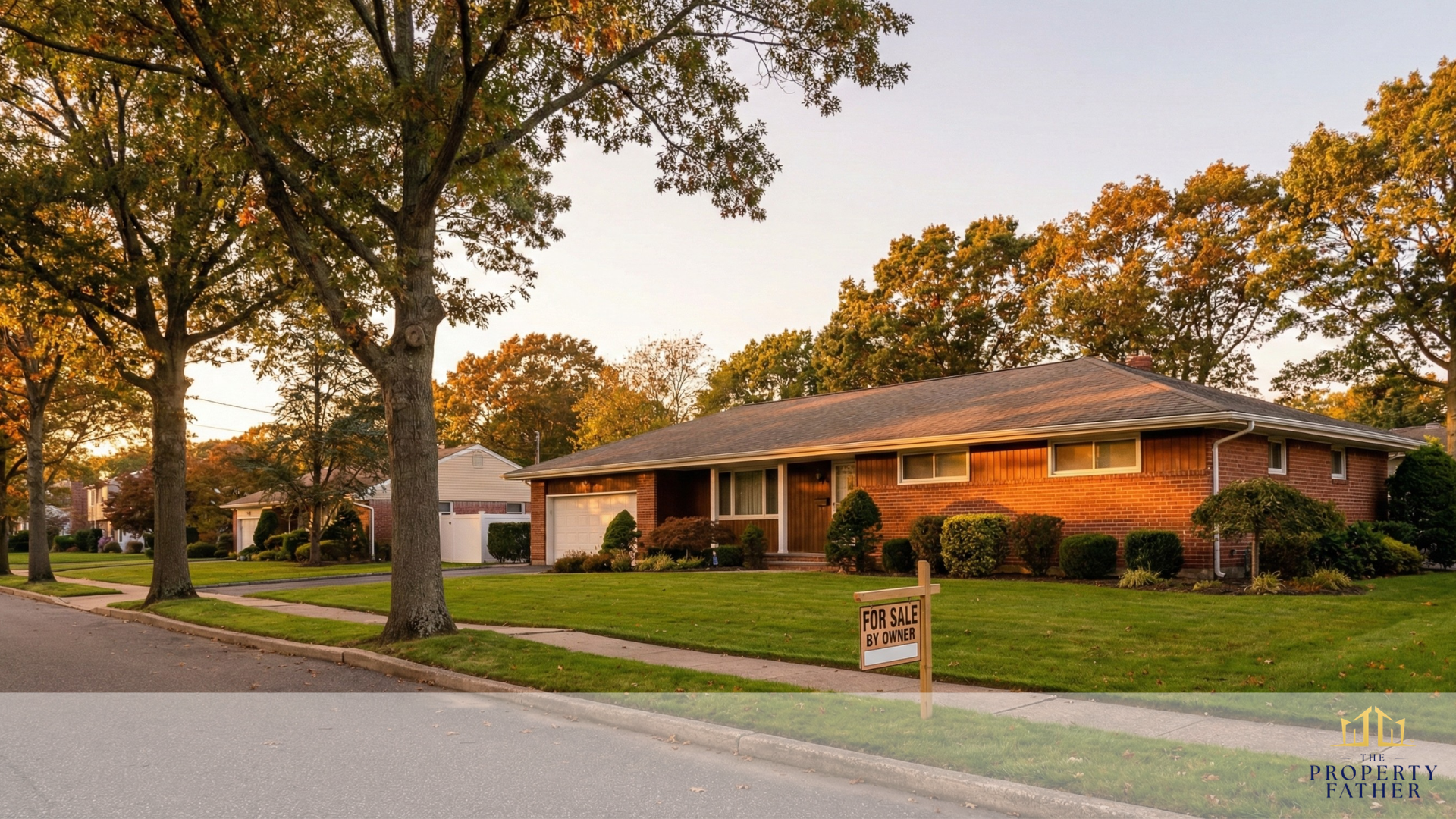
You’ve seen the signs zip-tied to telephone poles and the mailers stuffed in your mailbox: We Buy Houses — Any Condition — Fast Cash. Maybe you’re dealing with a foreclosure notice, an inherited property you can’t afford to maintain, or a divorce that’s forcing a sale on a tight timeline. Whatever brought you here, the question is the same: how do “we buy houses” companies actually work — and should you trust them?
In 2026, direct cash buyers have become a legitimate alternative for thousands of Long Island homeowners who need speed, certainty, and simplicity over maximum sale price. According to ATTOM Data Solutions, which tracks residential transaction data nationwide, cash purchases have grown steadily as a share of the market in recent years — reflecting a real shift in how sellers are approaching distressed and time-sensitive situations. This guide pulls back the curtain on the entire process — from how offers get calculated to what happens on closing day — so you can make an informed decision about whether this path is right for you.
Watch: How cash home sales actually work on Long Island — the complete 5-step process from first contact to closing day, including how offers are calculated, what happens with title issues, and how to spot a legitimate buyer.
How “We Buy Houses”
Companies Work
A fast-track guide for Long Island homeowners · 2026
Ready to Sell Your Long Island Home?
No repairs. No showings. Close in as little as 7 days.
Nassau County & Suffolk County.
What “We Buy Houses” Companies Actually Are (And What They’re Not)
Before anything else, let’s clear up the terminology. “We buy houses” companies are direct cash buyers — sometimes called investors, direct buyers, or home buying companies — who purchase properties without involving mortgage lenders, real estate agents, or the traditional listing process.
They are not the same as:
- Real estate agents or brokers, who represent you in finding a buyer on the open market
- iBuyers like Opendoor or Offerpad, which are tech-driven platforms that use algorithms to make offers — see our full Opendoor vs. local cash buyers breakdown for how they compare
- Wholesalers, who sign a contract with you and then sell that contract to another buyer — for a deeper look at that distinction, see cash buyer vs. wholesaler
A legitimate local cash buyer like The Property Father is the actual purchaser. They use their own funds, close directly with you, and take ownership of the property at closing. There are no middlemen, no bank approval timelines, and no deals falling through because a buyer’s mortgage got denied.
How Do “We Buy Houses” Companies Work? The Step-by-Step Process
Step 1: You Reach Out and Share Basic Property Details
The process starts with a conversation — typically a phone call or online form. You’ll share basic information about the property: address, condition, whether there are any liens or mortgages, and your situation. There’s no need to clean, stage, or prepare anything.
Most reputable cash buyers schedule a brief walkthrough within 24–48 hours. Unlike a traditional buyer’s inspection — which can trigger a long list of repair demands — this walkthrough is simply to understand what they’re buying. The condition of the home is already factored into the offer.
Step 2: The Offer Calculation
The formula is more straightforward than most people expect:
Cash Offer = After Repair Value (ARV) − Repair Costs − Holding Costs − Profit Margin
- ARV is what the home would sell for on the open market after repairs are complete
- Repair costs cover everything from cosmetic updates to structural issues
- Holding costs include property taxes, insurance, and any financing the buyer pays while renovating and reselling
- Profit margin is what makes the business model viable
This is why cash offers are typically lower than what you’d see on Zillow or from a traditional listing. However, you’re also not paying agent commissions (which vary by transaction — 5–6% was a common pre-settlement benchmark, but commission rates are negotiable and no longer standardized following the August 2024 NAR settlement), spending $10,000–$30,000 on repairs and staging, or waiting 60–90 days total for a buyer’s mortgage to clear and closing to complete.
Advisory Note: Real estate agent commission rates are no longer standardized at any fixed percentage following the NAR settlement effective August 17, 2024. The 5–6% range referenced above is a historical benchmark. Sellers should confirm current commission terms with any agent they engage before signing a listing agreement.
Our guide on why cash offers are lower — and whether it still makes sense for your situation — is worth reading before you decide.
A reputable company will explain their calculation clearly and answer every question you have. If they won’t — that’s a red flag worth taking seriously.
Step 3: You Review and Accept (or Decline) the Offer
There’s no obligation to accept. A legitimate cash buyer makes their offer, explains their numbers, and gives you time to think. They should also encourage you to have a real estate attorney review any contract before signing.
In New York, attorney representation at residential real estate closings is standard practice. The New York State Bar Association provides resources on what to expect in New York real estate transactions, and working with your own attorney protects your interests regardless of which type of sale you pursue.
Before you sign anything, review our list of questions to ask any cash buyer so you know exactly what to look for. If the offer works for your situation, you sign the purchase agreement and pick a closing date. Most sellers in straightforward transactions can close in 7–14 days once all title issues are resolved. If you need more time — say, 30 days to coordinate a move — that’s usually accommodatable.
Step 4: Title Search and Clearance
Once the contract is signed, the buyer orders a title search to confirm ownership and identify any outstanding issues: unpaid property taxes, mechanics’ liens, divorce-related claims, or estate complications.
This step is where distressed properties often hit snags in traditional sales. With a cash buyer, these complications are expected and planned for. Because they’ve handled similar situations across Nassau County and Suffolk County, they typically have existing relationships with the title companies and attorneys who resolve these issues efficiently.
Common title complications on Long Island include:
- Outstanding property tax balances
- Liens from contractors or HOA fees
- Estate issues from properties that passed through inheritance
- Divorce-related claims requiring both spouses to sign
The CFPB’s homeownership resources provide helpful background on how title searches and closings work — a useful reference before you get to that stage. For more on what the legal process looks like in a New York cash sale, see our guide on selling a house to a cash buyer — requirements in NY.
Step 5: Final Walkthrough and Closing Day
The cash buyer’s final walkthrough is simply a confirmation — “this is the property we agreed to purchase.” They’re not looking for reasons to renegotiate. If you’ve accurately described the home’s condition, this step is a formality.
Closing typically takes place at the buyer’s attorney’s office or a title company and usually wraps up in 30–60 minutes. You’ll review the HUD-1 Settlement Statement (or equivalent Closing Statement — the HUD-1 style is still standard for cash transactions in New York where no lender is involved), sign the deed, hand over the keys, and receive your proceeds. Most payments arrive via wire transfer within 24 hours; some buyers offer cashier’s checks at closing.
For a complete breakdown of what to bring and what to expect on closing day, see our comprehensive resource on selling your Long Island home fast.
Real Numbers: What You Actually Keep
The honest version of this comparison takes more than a quick glance at sale prices.
Advisory Note: The figures below are illustrative examples based on a hypothetical Nassau County home with a $400,000 market value requiring $25,000 in repairs. Actual net proceeds vary based on your property’s specific value, condition, outstanding liens, negotiated commission terms, and individual closing costs. These figures are not a guarantee of outcome. Consult a licensed real estate attorney and CPA for projections specific to your situation.
| Traditional Listing | Cash Buyer | |
|---|---|---|
| Sale / Offer Price | $400,000 | $345,000 |
| Realtor Commission (5.5% — illustrative; rates vary and are negotiable post-Aug 2024 NAR settlement)* | −$22,000 | $0 |
| Repair & Staging Costs | −$25,000 | $0 |
| Carrying Costs (60-day sale) | −$6,000 | $0 |
| Closing Costs | −$4,000 | $0 |
| Net Proceeds | ~$343,000 | ~$345,000 |
| Timeline | 3–5 months total | 7–14 days |
Commission rates are not standardized following the August 2024 NAR settlement. Confirm terms with any agent you engage.
According to NAR Research & Statistics, traditional sales on Long Island — accounting for days on market plus the 30–45-day financing and closing period — typically run 60–90 days from listing to closing in Nassau County, and somewhat shorter in parts of Suffolk County. For sellers facing foreclosure, divorce deadlines, or urgent relocation, that time difference isn’t just money — it’s stress, legal exposure, and emotional bandwidth.
As you can see in the comparison above, the dollar difference narrows significantly once you factor in what you’re not spending. For a full side-by-side breakdown, our true cost of selling with a realtor guide walks through every fee in detail.
Who Uses “We Buy Houses” Companies — And Why
Foreclosure. If you’ve received a notice of default, your window to act is limited. A cash sale can close before the auction date, allowing you to walk away with equity instead of losing everything. New York Homes & Community Renewal provides state-level resources for homeowners facing foreclosure. Our guide on facing foreclosure on Long Island covers every option available to you.
Divorce. When a court order requires a home to be sold and proceeds divided, speed matters. Showings and months of negotiations only add stress to an already difficult process. A cash sale eliminates most of that friction.
Inherited Property. Handling a deceased family member’s home while managing grief and probate proceedings is overwhelming. Cash buyers are experienced with estate complications and multiple heirs.
As-Is Condition. If the home needs significant work — a damaged roof, outdated systems, foundation issues — listing traditionally means either paying for repairs upfront or accepting heavily discounted offers. Selling as-is skips both.
Relocation. A job offer with a 30-day start date doesn’t allow time for a traditional listing cycle. Cash buyers can match your timeline when the market can’t.
What Separates Legitimate Cash Buyers from Problematic Ones
Signs of a Legitimate Buyer:
- Provides proof of funds within 48 hours of making an offer
- Encourages — rather than discourages — you to hire your own attorney
- Offers a formal purchase agreement, not just a verbal commitment
- Explains their offer calculation transparently
- Has verifiable local reviews and references
- Doesn’t pressure you to sign immediately or create artificial urgency
- Can confirm they are the actual buyer — not a wholesaler who will assign the contract
Warning Signs to Watch For:
- Refuses to show proof of funds
- Asks you to sign documents without reviewing them with an attorney
- Changes the offer price at or near closing
- Requires upfront fees or deposits from you
- Won’t explain how they arrived at their number
- Uses high-pressure tactics or “this offer expires tonight” language
If you’re working with a reputable company, they welcome questions. For a full breakdown of how to spot bad actors, see our guide on cash home buyer scams to avoid.
A Suffolk County Case Study: Inherited Home, Competing Heirs, Tight Timeline
Three adult children inherit their parents’ home in Babylon. One wants to sell immediately. One wants to keep it. One lives out of state and just wants the process to be over.
In a traditional listing, this scenario drags for months — or longer if a disagreement escalates. Repairs become a negotiating point. Every showing requires coordination across three schedules. Meanwhile, the estate stays open, accruing costs.
With a cash buyer, the process looked entirely different. Within a week of the initial call, the company walked the property, confirmed the estate documents with the family’s attorney, and made an offer reflecting the home’s as-is condition. All three heirs reviewed the contract with their own attorney, agreed, and signed. Closing happened 12 days later. The proceeds were split, the estate closed, and everyone moved forward.
It wasn’t the highest possible number. But it was the number that actually happened — without the uncertainty, the delay, or the family conflict that typically follows a contested listing.
How “We Buy Houses” Companies Differ by County on Long Island
The process is consistent whether you’re in Nassau or Suffolk, but county-specific factors affect timeline and paperwork. For context on the broader market, our Long Island real estate trends guide covers what sellers need to know in 2026.
Nassau County sellers often deal with higher average property values and more complex HOA situations. Title issues can sometimes take slightly longer to resolve given recording office volume.
Suffolk County sellers may encounter estate complications related to agricultural or waterfront properties. Rural towns can have unique zoning or title requirements that a locally experienced buyer will already know how to navigate.
Either way, working with a buyer who knows Long Island — not just a national brand with local franchises — matters. Local buyers have existing relationships with the county recording offices, title companies, and real estate attorneys who make closings happen on schedule.
Common Questions About How “We Buy Houses” Companies Work
Is the offer negotiable? Yes, in most cases. Reputable buyers present their offer with a clear breakdown, and if you have documentation of completed repairs or a recent appraisal, you can discuss it.
Do I need to make any repairs before selling? No. Cash buyers purchase homes as-is — the condition is factored into the offer from the start.
What if there’s still a mortgage on the property? Not a problem. At closing, your outstanding mortgage balance is paid off from the sale proceeds before you receive your net amount.
What if title issues come up? Experienced cash buyers expect this — especially with distressed or inherited properties. They work with title companies and attorneys to resolve liens and estate issues before closing.
Am I locked in once I sign the contract? Not necessarily. Most purchase agreements have specific cancellation terms. Our guide on cash buyer requirements in NY covers what to review with your attorney before signing.
Ready to Sell Your Long Island Home Fast?
Now you know how “we buy houses” companies actually work — the offer formula, the timeline, the title process, and how to tell the real operators from the ones to avoid. No repairs, no showings, no waiting on a buyer’s mortgage approval. Just a direct path from offer to closed, often in 7–14 days for straightforward transactions.
If you’re weighing your options, see the complete resource: Selling Your Long Island Home Fast
Questions? Call (516) 548-6558 to speak with our team about your specific situation.