

Signing documents that transfer your Long Island home’s ownership requires absolute confidence in who you’re dealing with and what you’re agreeing to. Yet many homeowners—particularly those in urgent situations like foreclosure, divorce, or estate settlement—feel pressured to skip due diligence and trust cash buyers at face value. Learning the right questions to ask cash buyers protects your largest asset from fraud, ensures fair treatment, and helps you make informed decisions.
In 2026, Nassau and Suffolk County sellers have access to legitimate cash buyers providing valuable services, but predatory operators also target distressed homeowners with deceptive practices. The difference between a beneficial transaction and costly mistake often comes down to asking specific, pointed questions before signing anything—and carefully evaluating the answers you receive.
This article provides 25 essential questions organized by category, explains what answers indicate legitimacy versus red flags, and gives you the framework to confidently vet any cash buyer. These aren’t theoretical questions—they’re battle-tested inquiries that expose scammers, verify qualifications, and ensure you’re working with professionals who will honor their commitments.
25 Critical Questions
Ask Before Signing Anything
📋 Business (1–5)
💰 Financing (6–10)
🏠 Offer (11–17)
⚙️ Process (18–25)
🚨 Walk Away If They:
✓ Legit Buyers Will:
About Their Business (Questions 1-5)
Start by verifying basic business legitimacy before discussing your property.
Question 1: “How long have you been buying properties?”
Why it matters: Track record indicates stability and experience. New operations (under 2 years) may lack capital, systems, or staying power to close transactions reliably.
Legitimate answers:
- “We’ve been operating for 8 years, purchasing 40–60 Long Island properties annually”
- “Our company started in 2018 and we’ve completed 200+ acquisitions”
- Specific years and verifiable transaction history
Red flag answers:
- “We just started but have lots of experience” (vague, unverifiable)
- Refusing to provide specific timeline
- Claims of decades of experience with no proof
- Different names/companies mentioned (frequent rebranding suggests problems)
Follow-up: Ask for specific addresses of recent purchases you can verify through public records.
Question 2: “Can you provide your business registration and license information?”
Why it matters: New York State requires business registration for all companies operating here. Legitimate businesses willingly provide documentation.
Legitimate answers:
- Provides NY Department of State business ID number immediately
- Shows active registration status you can verify online
- Explains their business structure (LLC, Corporation)
- Provides real estate license if they act as brokers
Red flag answers:
- “We’re a private company, we don’t need registration” (false)
- Delays or refuses to provide information
- Provides registration from other states only
- Shows expired or inactive registration
Follow-up: Verify their registration status yourself at the NY Department of State business database—don’t rely solely on documents they provide.
Question 3: “What’s your company’s physical address?”
Why it matters: Legitimate businesses operate from real offices. PO boxes only or residential addresses suggest lack of established operations.
Legitimate answers:
- Provides commercial office address
- Address matches business registration records
- Willing to meet at their office
- Professional office setup visible online (Google Street View)
Red flag answers:
- Only PO box provided
- Residential address given as business location
- Refuses to provide address
- Address doesn’t match business registration
- Claims “we work remotely” without any physical presence
Follow-up: Verify the address exists and appears professional using Google Maps and Street View.
Question 4: “Can you provide references from recent sellers?”
Why it matters: Past sellers offer unbiased perspectives on working with the company. Legitimate buyers proudly provide references.
Legitimate answers:
- Provides contact information for 3–5 recent sellers
- References are from last 6–12 months (recent)
- Willing to provide more references if you request
- References describe positive, professional experiences
Red flag answers:
- “Privacy concerns prevent us from sharing references” (excuse)
- Provides only 1–2 references from years ago
- References seem scripted or connected to the company
- Refuses entirely to provide any references
Follow-up: Actually call references and ask about their experience, timeline, whether offers were honored, and any issues that arose.
Question 5: “What’s your Better Business Bureau rating?”
Why it matters: BBB ratings and complaint history reveal patterns of problems. While not perfect, consistently poor ratings signal issues. Checking BBB alongside Google and other review platforms gives you a fuller picture when evaluating whether we buy houses companies are legit.
Legitimate answers:
- “We’re A-rated” or “We’re not BBB accredited but have no complaints”
- Acknowledges any complaints and explains resolution
- Encourages you to check reviews on multiple platforms
Red flag answers:
- Doesn’t know their rating
- Dismisses BBB entirely as irrelevant
- Has numerous unresolved complaints
- Rating doesn’t match what you find online
Follow-up: Search “[Company Name] BBB” and “[Company Name] reviews complaints” to see what others report.
About Their Financing (Questions 6-10)
Verify they actually have funds to close before investing time in their offers.
Question 6: “Can you provide proof of funds right now?”
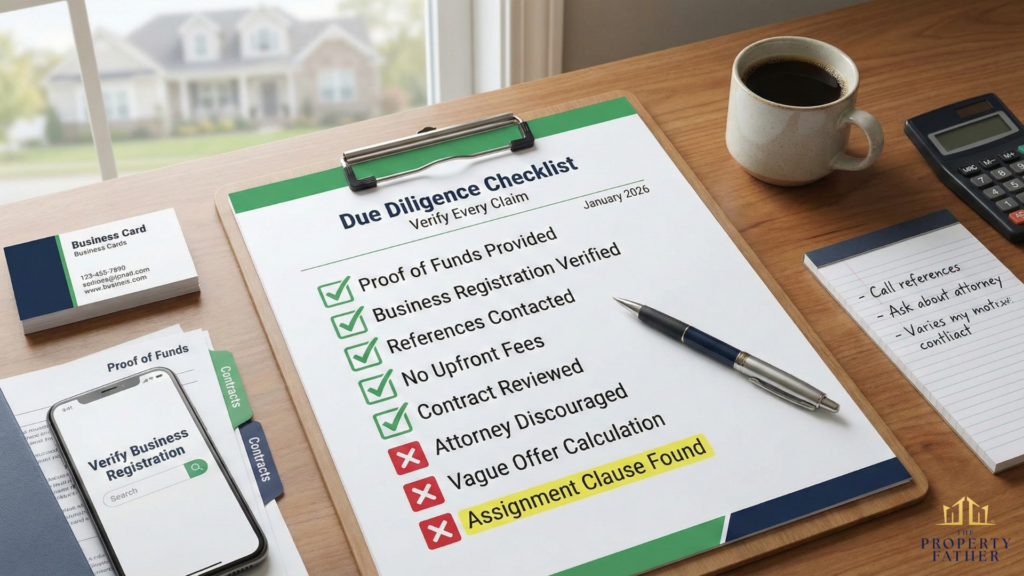
Why it matters: This is the most critical verification. Anyone can make offers—only legitimate buyers can prove ability to close. Requesting proof of funds before proceeding is standard real estate due diligence.
Legitimate answers:
- “Absolutely, I’ll email bank statements within the hour”
- Immediately provides recent bank statements showing sufficient funds
- Offers to have your attorney verify with their bank directly
- Provides pre-approval letter from lender if using financing
Red flag answers:
- “You’ll see proof of funds at closing” (too late)
- Delays providing documentation beyond 24 hours
- Provides screenshots that could be fabricated
- Shows insufficient funds for your purchase price
- “Our partners provide funding” (wholesaler red flag)
Follow-up: Verify bank statements by calling the bank directly using phone numbers from the bank’s official website, not numbers on provided documents.
Question 7: “Are you the actual buyer, or will you assign this contract?”
Why it matters: Wholesalers pretending to be buyers create uncertainty. Actual buyers close directly; wholesalers must find end buyers, introducing delays and renegotiation. Understanding how we buy houses companies work can help you distinguish between the two.
Legitimate answers:
- “We are the buyer and will close directly in our company name”
- “Our company purchases and holds properties”
- Shows proof they own multiple properties currently
Red flag answers:
- “We work with partners who might take the assignment”
- Contract includes “and/or assigns” language
- “Subject to partner approval” contingencies
- Evasive non-answers about direct purchase
Follow-up: Review the purchase contract carefully—if it says “ABC Company and/or assigns,” you’re dealing with a wholesaler.
Question 8: “What contingencies does your offer include?”
Why it matters: Cash offers’ primary value is certainty. Contingencies (financing, inspection satisfaction, partner approval) eliminate that certainty.
Legitimate answers:
- “Only title contingency—standard for all sales”
- “No financing contingency—we’re paying cash”
- “No inspection contingency—we buy as-is”
- Explains that title issues would be the only reason not to close
Red flag answers:
- “Subject to satisfactory inspection” (gives unlimited renegotiation power)
- “Contingent on financing approval” (not actually a cash offer)
- “Subject to partner approval” (wholesaler language)
- Multiple contingencies that allow backing out easily
Follow-up: Have your attorney review all contingencies to understand what circumstances allow them to reduce price or cancel.
Question 9: “Have you ever failed to close on a property you offered on?”
Why it matters: Closing reliability separates professionals from amateurs. Track record of completing purchases indicates ability to follow through.
Legitimate answers:
- “We’ve closed 98% of offers accepted—only title issues prevented 2 closings”
- Acknowledges rare failures with valid explanations
- Provides evidence of consistent closing history
Red flag answers:
- “We haven’t failed but we’re selective” (evasive)
- Admits frequent failures to close
- Blames sellers for previous deal collapses
- Can’t provide any transaction history
Follow-up: Ask for documentation of their last 5–10 closed transactions showing they actually complete purchases.
Question 10: “How quickly can you close?”
Why it matters: Timeline indicates both capability and whether their offer matches your needs. Legitimate cash buyers in New York typically close in 7–21 days from signed contracts, depending on title complexity and attorney scheduling—New York’s attorney review and title coordination requirements mean closings may run slightly longer than national averages. You can learn more about what realistic timelines look like in our guide to how fast cash home sales close.
Legitimate answers:
- “7–21 days from signed contracts, depending on title search and attorney availability”
- “As quickly as your attorney needs—we can close in 10–14 days on a clean title”
- Provides specific timeline with explanation of steps
Red flag answers:
- “24–48 hours” (unrealistic in New York—title search alone can take several business days to two weeks depending on the property’s history)
- “Whenever you need” without any process explanation
- Timeline keeps changing during conversations
- Claims speed but shows no urgency in follow-up
Follow-up: Confirm the timeline in writing and understand what steps need to occur before closing.
About Their Offer (Questions 11-17)
Understand exactly what they’re offering and how they calculated it.
Question 11: “How did you calculate this offer?”
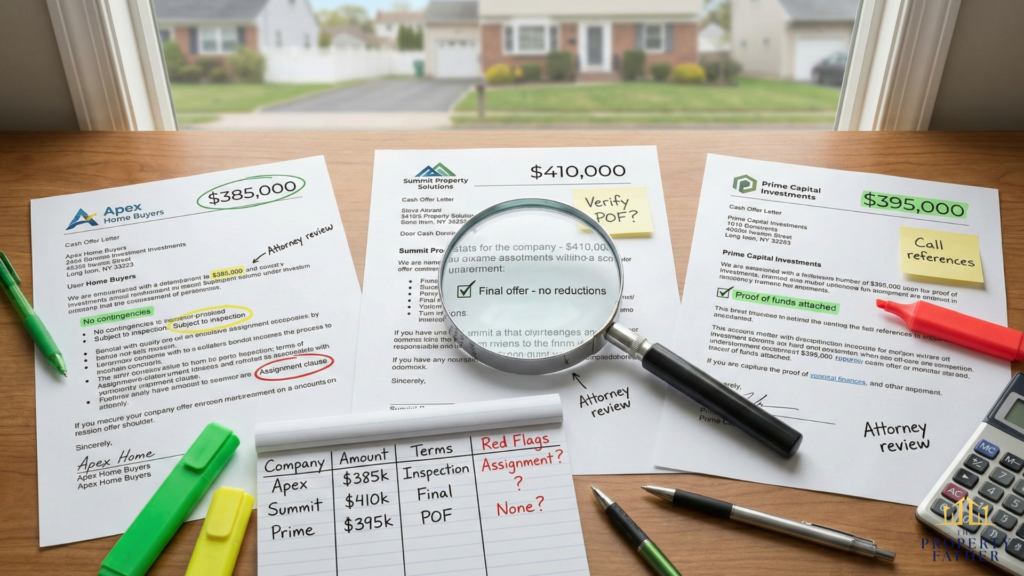
Why it matters: Transparent methodology distinguishes fair offers from arbitrary lowballs. Legitimate investors willingly explain their math. Understanding whether cash buyers pay fair prices starts with understanding their calculation process.
Legitimate answers:
- Shows ARV based on comparable sales
- Provides repair cost estimates with contractor quotes
- Breaks down holding costs, transaction fees, profit margin
- Walks through entire calculation step by step
Red flag answers:
- “Based on our analysis” (vague, no specifics)
- Refuses to show methodology
- Can’t explain components of calculation
- Gets defensive when asked about pricing
Follow-up: Request written breakdown showing: ARV, repair costs, holding costs, transaction costs, and profit margin.
Question 12: “What comparable sales did you use to determine value?”
Why it matters: Offers should reflect actual Long Island market data, not arbitrary values. Comparable sales prove they did legitimate research.
Legitimate answers:
- Shares 5–8 comparable properties with addresses
- Shows sales from last 6 months in your neighborhood
- Comparables have similar size, age, condition
- Explains adjustments made for differences
Red flag answers:
- Can’t provide any comparable sales
- Uses properties from different neighborhoods or towns
- Comparables from years ago
- Vastly different property types or sizes
Follow-up: Verify the comparable sales yourself using Zillow, Realtor.com, or your county’s property records.
Question 13: “What repairs are you factoring into your offer?”
Why it matters: Repair deductions should reflect actual needed work, not inflated estimates used to justify low offers.
Legitimate answers:
- Offers a detailed list of repairs needed
- Shows contractor estimates for major items
- Explains which repairs affect marketability
- Willing to have you verify estimates with your own contractors
Red flag answers:
- Lists repairs your home doesn’t need
- Dramatically inflates repair costs
- Won’t provide any detail about repair assumptions
- Claims “everything needs updating” without specifics
Follow-up: Get your own contractor estimates for major repairs to verify their numbers are reasonable.
Question 14: “Is this your final offer, or might it change?”
Why it matters: Offer reliability prevents bait-and-switch tactics where attractive initial offers get reduced just before closing. This is one of the clearest distinctions in a cash buyer vs. realtor comparison—cash offers should come with price certainty.
Legitimate answers:
- “This is our firm offer based on current property condition”
- “Only title issues would affect the offer”
- “We honor our written offers”
- Explains rare circumstances that might require adjustment (undisclosed liens, etc.)
Red flag answers:
- “We’ll need to inspect before finalizing”
- “This could change based on what we find”
- “Subject to final walkthrough approval”
- Evasive about offer firmness
Follow-up: Get the offer in writing with clear statement that price won’t be reduced except for title issues or undisclosed property conditions.
Question 15: “What closing costs will I pay?”
Why it matters: Unexpected fees reduce net proceeds. Legitimate buyers transparently disclose all seller costs upfront. For a full breakdown of what selling expenses look like, see our guide to the true cost of selling with a realtor for comparison.
Legitimate answers:
- Provides itemized estimate of seller closing costs
- Explains standard New York seller costs (transfer taxes, attorney fees, title fees)
- No hidden fees or surprise charges
Red flag answers:
- Mentions “assignment fees” or “processing fees”
- Vague about total costs
- Additional fees not mentioned initially
- Costs keep increasing during discussions
Advisory Note: Seller closing costs in New York vary based on sale price, county, outstanding liens, title insurance costs, and individual circumstances. Common seller-side costs include New York State transfer tax, attorney fees, and any outstanding property tax or lien payoffs. Have your attorney prepare a personalized closing cost estimate before signing anything. Additionally, as of March 20, 2024, New York sellers of 1–4 family residential properties are required to complete the full Property Condition Disclosure Statement — the $500 credit-in-lieu option has been eliminated. Selling as-is does not exempt most sellers from this requirement. Consult your attorney for guidance specific to your situation. See the NYSBA analysis of the 2024 PCDS amendment for full details.
Follow-up: Have your attorney review the estimated closing statement before signing to verify all costs.
Question 16: “Will you pay my outstanding mortgage and liens?”
Why it matters: Some sellers have mortgages exceeding offer prices or complicated lien situations requiring resolution.
Legitimate answers:
- “Yes, we’ll work with your lender to pay off the mortgage”
- “We’ll handle lien resolution through title company”
- Explains how proceeds will be distributed
- Clarifies if you’ll need to bring money to closing (if underwater)
Red flag answers:
- Unclear about mortgage payoff process
- Suggests unconventional payoff arrangements
- Won’t commit to paying existing liens
- Proposes you transfer title before mortgage payoff
Follow-up: Verify through your attorney that mortgage and all liens will be satisfied at closing before title transfers.
Question 17: “Do you require any upfront fees or deposits from me?”
Why it matters: Legitimate cash buyers never require sellers to pay upfront fees. Any request for advance payment signals a scam.
Legitimate answers:
- “No, you pay nothing upfront—we cover all our evaluation costs”
- “The only costs you’ll have are at closing: attorney and transfer taxes”
- Clear statement that no pre-closing payments are required
Red flag answers:
- Requests inspection fees, processing fees, or any advance payments
- “Small deposit required to lock in the offer”
- “Administration fee to prepare paperwork”
- Any request for you to pay them before closing
Follow-up: Walk away immediately from anyone requesting upfront payments—this is always a scam.
About the Process (Questions 18-22)
Understand exactly what happens from offer acceptance to closing.
Question 18: “What steps happen between now and closing?”
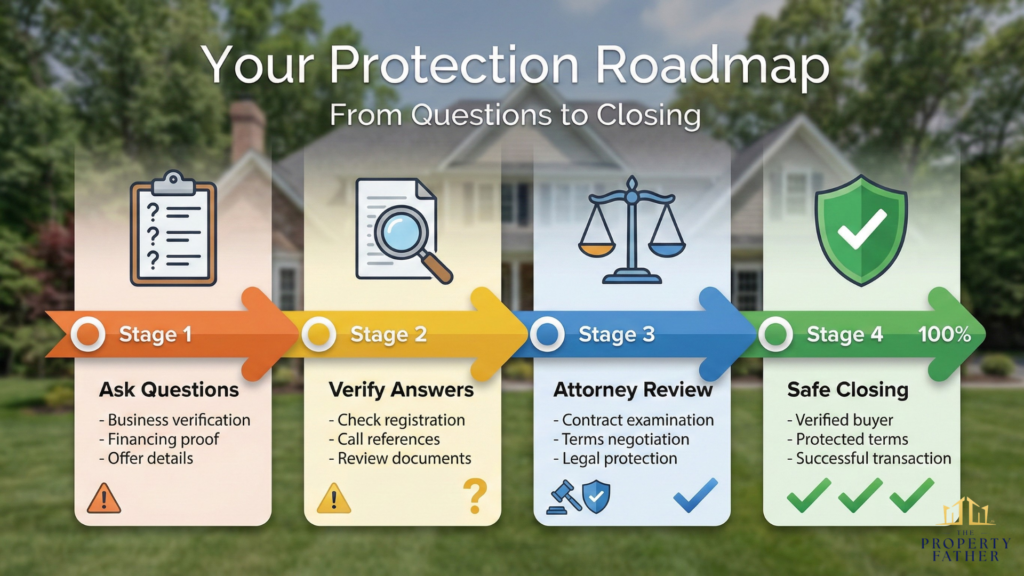
Why it matters: Clear process understanding prevents surprises and shows the buyer’s professionalism.
Legitimate answers:
- Detailed timeline: contract signing → title search → attorney review → closing
- Explains each party’s responsibilities at each step
- Provides realistic timeline for each phase
- Willing to coordinate with your schedule
Red flag answers:
- Vague about process details
- Can’t explain next steps clearly
- Timeline seems rushed or unclear
- Avoids discussing attorney involvement
Follow-up: Get the timeline in writing with specific dates and responsibilities.
Question 19: “Do you require me to have an attorney?”
Why it matters: While New York law does not technically mandate that buyers or sellers retain an attorney, it is strongly advisable and universal standard practice in New York real estate transactions. Under New York State rules, real estate brokers are prohibited from drafting contracts of sale—those must be prepared by the principal or their attorney. The NY State Bar Association strongly advises all parties to secure independent legal representation. Legitimate cash buyers respect and encourage this.
Advisory Note: New York does not have a statute explicitly requiring attorney representation for real estate transactions; however, it is standard practice, and real estate contracts must be drafted by the principal or their attorney under New York practice rules. Always retain your own independent attorney when selling your home.
Legitimate answers:
- “We strongly encourage you to have your own attorney—it protects both parties”
- “We work with attorneys regularly and expect your attorney to be involved”
- Recommends you hire your own independent counsel
- Works professionally with attorneys regularly
Red flag answers:
- “Attorneys aren’t really necessary for simple sales”
- “You can use an attorney if you want, but it’s not required”
- Discourages legal representation
- Suggests using their recommended attorney
Follow-up: Hire your own attorney immediately—never use buyer-recommended attorneys.
Question 20: “Can I choose the closing date?”
Why it matters: Flexibility with timing shows they’re accommodating your needs, not just their convenience.
Legitimate answers:
- “Yes, we can close on your preferred date within reason”
- “Our timeline is flexible—when works best for you?”
- Explains any constraints honestly (title search time, attorney availability)
Red flag answers:
- Insists on specific closing date with no flexibility
- Pressures for immediate closing without regard to your needs
- Won’t accommodate reasonable requests
- Changes closing dates repeatedly
Follow-up: Confirm closing date flexibility in writing before signing contracts.
Question 21: “What happens during the final walkthrough?”
Why it matters: Understanding final walkthrough expectations prevents last-minute surprises or attempted renegotiations.
Legitimate answers:
- “Standard walkthrough to confirm property condition hasn’t changed”
- “We just verify nothing major has changed since our initial visit”
- Clarifies they’re not looking for reasons to reduce price
- Explains this is procedural, not a new inspection
Red flag answers:
- “We’ll need to reinspect everything thoroughly”
- Uses walkthrough language suggesting opportunity to renegotiate
- Unclear about walkthrough purpose
- Suggests price adjustments are common at walkthrough
Follow-up: Have your attorney include contract language limiting walkthrough to verification of no material changes.
Question 22: “How will I receive my proceeds?”
Why it matters: Payment method and timing affect your financial planning and security.
Legitimate answers:
- “Wire transfer same day as closing” or “Cashier’s check at closing”
- Explains exact payment method and timing
- Coordinates with your attorney on proceeds distribution
- Transparent about any holds or delays
Red flag answers:
- Vague about payment methods
- Suggests unusual payment arrangements
- Payment timing unclear or delayed
- Won’t commit to specific payment method
Follow-up: Verify payment method with your attorney and title company to ensure security.
About Them Personally (Questions 23–25)
Understand who you’re really dealing with.
Question 23: “Have you personally inspected my property?”
Why it matters: Serious buyers visit properties before making offers. Remote offers without inspection often indicate wholesalers or scammers.
Legitimate answers:
- “Yes, I walked through your property last Tuesday”
- “I’ll schedule a visit this week before making an offer”
- Remembers specific details about your property
- Takes photographs and measurements during visit
Red flag answers:
- Makes offer without ever visiting
- Sends representatives instead of decision-makers
- Can’t recall details about your property
- Relies entirely on photos you provided
Follow-up: Legitimate buyers should visit your property and demonstrate familiarity with its actual condition.
Question 24: “Who will I be working with throughout this process?”
Why it matters: Knowing your point of contact and their authority ensures efficient communication and decision-making.
Legitimate answers:
- Introduces you to specific point of contact with authority
- Provides direct phone numbers and email addresses
- Explains roles of team members (acquisitions, closing coordinator, etc.)
- Responsive and available for questions
Red flag answers:
- Constantly changing contacts
- No clear point person
- Difficult to reach or unresponsive
- Low-level staff with no decision authority
Follow-up: Save contact information and test responsiveness by asking follow-up questions.
Question 25: “What happens if something goes wrong?”
Why it matters: Professional businesses have contingency plans and problem resolution processes.
Legitimate answers:
- Explains their problem resolution process
- Provides examples of how they’ve handled issues before
- Takes responsibility for solving problems
- Gives escalation path if needed
Red flag answers:
- Dismisses possibility of problems
- No clear process for issue resolution
- Blames external factors when issues arise
- Makes everything seem impossibly smooth
Follow-up: Understand what recourse you have if they fail to perform as promised.
Red Flag Response Patterns
Beyond specific answer content, watch for these concerning response patterns:
Evasion and Deflection
- Answering different questions than you asked
- Vague responses without specifics
- Topic changes when pressed for details
- Becoming defensive or irritated by questions
Inconsistency
- Different answers to the same question over time
- Information conflicting with what’s documented
- Facts changing between conversations
- Team members giving contradictory information
Pressure and Rush
- Discouraging thorough due diligence
- Artificial urgency designed to prevent verification
- You’re made to feel problematic for asking questions
- Claims of waiting “other buyers” used to pressure you
Lack of Documentation
- Verbal promises not matched in writing
- Refusing to provide requested documents
- Documentation inconsistent with statements
- No paper trail for agreements or commitments
If you notice these patterns, walk away regardless of how attractive the offer seems. Understanding how to identify cash home buyer scams protects your property equity.
How to Use These Questions Effectively
Asking questions is only valuable if you do it strategically.
Timing
- Raise Questions 1–5 (business verification) in your first conversation, before discussing your property
- Ask Questions 6–17 (financing and offer) once you receive a written offer
- Save Questions 18–25 (process and people) for before signing contracts
Documentation
- Take notes during conversations
- Request written answers to key questions
- Save all documentation provided
- Create verification checklist tracking what you’ve confirmed
Verification
- Don’t rely solely on their answers—verify independently
- Use online tools (NY DOS, BBB, Google) to check facts
- Call references and past sellers
- Have your attorney review everything
Comparison
- Ask the same questions to multiple cash buyers
- Compare answers to identify inconsistencies
- Use answers to negotiate better terms
- Red flags from one buyer validate choosing another
Attorney Involvement
- Share answers with your attorney
- Have attorney review documentation provided
- Attorney can ask technical follow-up questions
- Legal counsel verifies contract terms match representations
Questions The Property Father Welcomes
Professional cash buyers embrace thorough due diligence because it demonstrates they have nothing to hide.
When sellers ask us these questions, here’s what we provide:
- Business verification: NY business registration, operating history, completed transactions, BBB rating
- Financial proof: Same-day proof of funds, bank statements showing capital, previous closing statements
- Offer transparency: Complete ARV calculation, contractor repair estimates, comparable sales data, profit margin disclosure
- Process clarity: Written timeline, respect for your attorney’s involvement, flexible closing dates, clear payment methods
- References: Contact information for recent sellers from the past year
Advisory Note: The specific transaction counts, tenure, and ratings referenced above are company-stated figures. Prospective sellers are encouraged to independently verify these claims through public records, BBB, Google reviews, and direct reference checks.
We encourage every seller to ask these questions—and to ask them of every cash buyer they’re considering. Comparison shopping using these questions helps you find professional partners delivering on their promises.
Understanding how to evaluate cash buyers ensures you work with legitimate operators providing fair value.
Ready to Sell Your Long Island Home?
Asking the right questions to cash buyers protects your property equity, verifies legitimacy, and ensures you make informed decisions. These 25 questions expose scammers, verify qualifications, and help you distinguish between professional investors and predatory operators.
The Property Father welcomes every question on this list. We operate with complete transparency, provide immediate verification of business credentials and financing, explain our offers in detail, and encourage comparison shopping. Professional investors don’t fear questions—we embrace them as signs of smart, protected sellers.
Get a fair, transparent offer in 24 hours with complete answers to every question that matters. We’ll provide proof of funds, explain our calculation methodology, show you comparable sales, and give you time to verify everything we say.
See our Long Island Home Selling Guide for a complete breakdown of your options.