

You’ve done it. After weeks—maybe months—of weighing your options, you’ve accepted a cash offer on your Long Island home. The relief is real, but so are the questions swirling in your head: What comes next? Did I leave money on the table? How fast will this actually close?
If you’re second-guessing whether cash home buyers pay fair price for properties, you’re not alone. Most sellers wonder if they made the right call until they see how smoothly the process unfolds compared to traditional sales. In 2026, Long Island homeowners facing foreclosure, divorce, or inherited property challenges are discovering that “fair” isn’t always about the highest number—it’s about what you keep after fees, how fast you need to move, and whether you can handle repairs and showings. Here’s exactly what happens after you sign that offer letter, and why thousands of sellers conclude cash buyers do pay fair prices when you factor in the full picture.
Do Cash Buyers Pay Fair Price?
What the Numbers Really Show
Fair Price = Speed + Certainty + What You Actually Keep
It’s not just about the offer amount—it’s about net proceeds after all costs, timeline, and avoiding deal failures.
Real Example: Nassau County Home
What Happens After You Accept
⚠ Red Flags to Watch For
When Cash Sales Make Sense
Why the Post-Offer Process Matters More Than You Think
The moment you accept a cash offer, you’re entering a fundamentally different transaction than a traditional sale. No mortgage underwriter will kill the deal at the eleventh hour, no appraisal will come back $30,000 under contract price. No buyer will demand you fix the HVAC system or replace the roof.
In Long Island’s competitive market—where properties in Suffolk and Nassau counties routinely face bidding wars but also lengthy contingency periods—cash sales eliminate virtually every point of friction. However, understanding the timeline and steps ahead helps you prepare mentally, financially, and logistically for closing day.
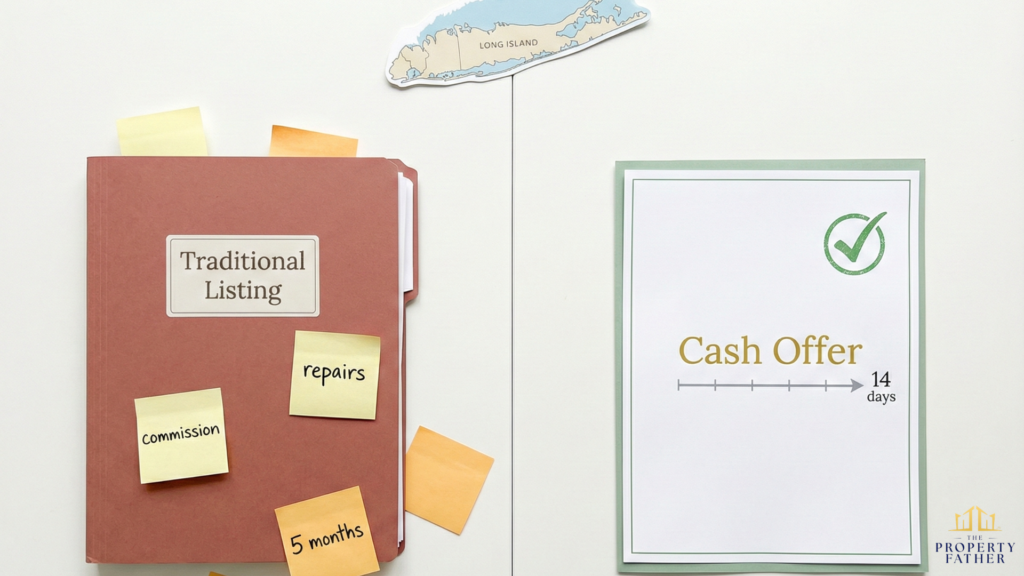
Most sellers worry they’re being lowballed when they first see a cash offer. It’s typically 10–25% below retail market value, depending on the property’s condition and location. But here’s what that number doesn’t show you: what you’d actually net from a traditional sale after agent commissions (which vary by transaction — 5–6% was a common historical benchmark prior to the August 2024 NAR settlement, and sellers should confirm current rates with any agent they engage), closing costs (2–4%), repairs demanded by buyers, carrying costs during a 4–6 month listing period, and the risk of deals falling through.
Advisory Note: Real estate agent commission rates are negotiable and are no longer standardized at any fixed percentage following the NAR settlement effective August 17, 2024. Do not assume 5–6% as a fixed cost. Confirm commission terms directly with any agent you work with before signing a listing agreement.
When you do the math, many Long Island homeowners discover the answer to “do cash home buyers pay fair price?” is yes — especially when speed and certainty have dollar values you can’t put on a spreadsheet.
The 72-Hour Window: Due Diligence Begins
Within 24–72 hours of accepting the offer, the cash buyer’s team starts verifying the details that will appear in the purchase agreement. This phase is quick but important. Here’s what’s happening behind the scenes:
Title Search and Lien Discovery
A title company begins researching your property’s ownership history, looking for liens, judgments, unpaid taxes, or other encumbrances that need to be resolved before closing. In Nassau and Suffolk counties, this process typically uncovers issues like:
- Unpaid property taxes (common in pre-foreclosure situations)
- Mechanics liens from contractor disputes
- Divorce decree requirements for spousal signatures
- Probate complications on inherited properties
The good news? Reputable cash buyers expect these issues and often handle the payoffs at closing. You’re not disqualified because you owe back taxes or have a lien — the buyer simply deducts what’s owed from your proceeds and ensures those debts are cleared when you sell.
Under New York’s Real Property Tax Law, property tax liens hold a high-priority position in the lien hierarchy, making title clearance essential before any sale can proceed. Consult your title attorney for how this applies to your specific property.
Property Inspection (But Not Like You Think)
Cash buyers do inspect the property, but they’re not looking for reasons to renegotiate. They’re confirming the condition matches what they based their offer on. Unlike traditional buyers who’ll demand you replace the water heater or credit them $5,000 for cosmetic issues, cash buyers made their offer knowing the property needs work.
This inspection typically takes 30–60 minutes. The buyer or their representative walks through, takes photos, measures rooms, and checks major systems. If something catastrophic is discovered that wasn’t disclosed — say, an entire foundation wall is collapsing — there might be a price adjustment discussion. But for normal wear and tear, outdated kitchens, or minor damage? The offer stands. This is precisely what does selling as-is mean in practice.
Contract Preparation
While due diligence runs, the buyer’s attorney drafts the purchase agreement. In New York State, both parties need legal representation for real estate transactions. If you don’t have an attorney, now’s the time to hire one.
Advisory Note: Attorney fees vary by firm, transaction complexity, and county. A rough estimate for a straightforward Long Island cash sale as of 2026 is $1,500–$2,500, but confirm fees directly with your attorney before engaging. Fees may be higher for transactions involving title complications, probate, or divorce.
The contract will specify:
- Purchase price and how it’s allocated (land vs. improvements for tax purposes)
- Closing date (usually 7–21 days from contract signing)
- What stays with the property (appliances, fixtures)
- Representations you’re making about the property’s condition
- Who pays which closing costs
This is the stage where you’ll see in writing whether the buyer is covering your closing costs (many cash buyers do) or if those come out of your proceeds.
Week One: Signing the Contract and Moving Toward Closing
Once due diligence clears and the contract is ready, you’ll meet with your attorney to review and sign. This is your last chance to ask questions before you’re legally committed to selling.
What You’re Actually Signing
The purchase agreement binds both parties to the transaction. You’re promising to deliver the property with clear title on the closing date. The buyer is promising to bring cash (or proof of funds) and complete the purchase.
In Long Island cash sales, contracts often include:
As-Is Clause: You’re selling the property in its current condition with no obligation to make repairs. This is the clause that makes cash buyers attractive to homeowners with properties that need significant work.
Expedited Closing Timeline: Traditional contracts give buyers 45–60 days to secure financing. Cash contracts often close in 7–14 days because there’s no mortgage contingency. If you’re wondering how fast you can sell a house for cash, the answer is typically within two weeks.
Seller Rent-Back Option: If you need extra time to move out, some cash buyers will let you stay in the property for 7–30 days post-closing, either free or for a nominal daily rate. This is especially helpful for sellers dealing with divorce or probate situations where coordinating moving logistics is complicated.
Proof of Funds
Before you sign, your attorney should verify the buyer has the cash to close. Legitimate buyers provide bank statements or a letter from their financial institution confirming they have liquid funds available. This protects you from buyers who claim to be cash purchasers but are actually trying to assign the contract to another investor. Knowing the difference between cash buyers and wholesalers can save you from delays and disappointments.
Week Two: Final Preparations and Title Clearing
The closing date is set. Now it’s about tying up loose ends so you can transfer ownership smoothly.
Resolving Title Issues
If the title search uncovered liens or judgments, this is when they get resolved. Your attorney and the title company work with creditors to prepare payoff statements — exact amounts needed to clear each debt, valid through the closing date.
For example, if you’re facing foreclosure on Long Island, the mortgage servicer will provide a payoff figure that includes the remaining loan balance plus any late fees or legal costs. The title company ensures that money gets wired directly to the lender when the sale closes, removing the lien from your property.
Sellers often ask: “Will the cash buyer really pay off my debts?” Yes, but not out of kindness — they’re required to deliver clear title to themselves. They pay those debts by deducting the amounts from your sale proceeds. If you owe $250,000 on your mortgage and accept a $300,000 cash offer, you’ll walk away with $50,000 minus closing costs (if you’re responsible for them) after the mortgage is paid off.
Coordinating Utilities and Move-Out
You’ll need to contact utility companies (PSEG Long Island, National Grid, etc.) to schedule disconnection or transfer effective the day after closing. Most sellers don’t realize they’re responsible for utility costs through the closing date, so leaving services on until then protects you from the buyer claiming you left the property in worse condition.
If you’re taking appliances or fixtures that would normally convey with the property, now’s the time to confirm in writing. Ceiling fans, wall-mounted TVs, and custom-built sheds can become sources of conflict if expectations aren’t clear.
Final Walk-Through
One to three days before closing, the buyer will do a final walk-through — confirming the property is in the same condition as when they made the offer and that you’ve removed your belongings. For as-is cash sales, this is usually a formality.
Closing Day: What to Expect When You Sign
Closing day in New York typically happens at the buyer’s attorney’s office or the title company. You’ll sit down with your attorney, the buyer or their representative, and usually a representative from the title company. The New York State Bar Association’s real estate resources provide helpful background on what New York closings involve.
Documents You’ll Sign
You’ll sign a lot of paperwork, but the three most important documents are:
Deed: This transfers ownership from you to the buyer. In New York, most residential sales use a bargain and sale deed with covenants against grantor’s acts, which promises you haven’t done anything to compromise the title during your ownership.
Closing Statement (also called a Settlement Statement): This is the seller’s financial summary — it breaks down the sale price, what you’re paying off, closing costs, and your net proceeds. Note: the Closing Disclosure is a mortgage-related document used in financed transactions and does not apply to cash sales. What you’ll sign in a cash closing is a Closing Statement prepared by the title company or closing attorney. Review this carefully before signing — if numbers don’t match what you were told, address it now.
Affidavit of Title: You’re swearing under oath that there are no unrecorded liens, judgments, or claims against the property, and that you haven’t made any improvements that aren’t paid for.
The Money Transfer
Cash buyers wire funds to the title company or their attorney’s trust account before closing. Your attorney verifies the money has arrived before you sign the deed. Once all documents are signed and notarized, the title company disburses funds according to the closing statement:
- Mortgage payoff goes to your lender
- Liens and judgments are paid off
- Closing costs (if you’re paying them) are deducted
- Your attorney’s fee is paid
- Your net proceeds are wired to your bank account or issued as a check
Most sellers receive their proceeds the same day as closing or the next business day if closing happens late in the afternoon.
Post-Closing: Your Responsibilities Don’t End at Signatures
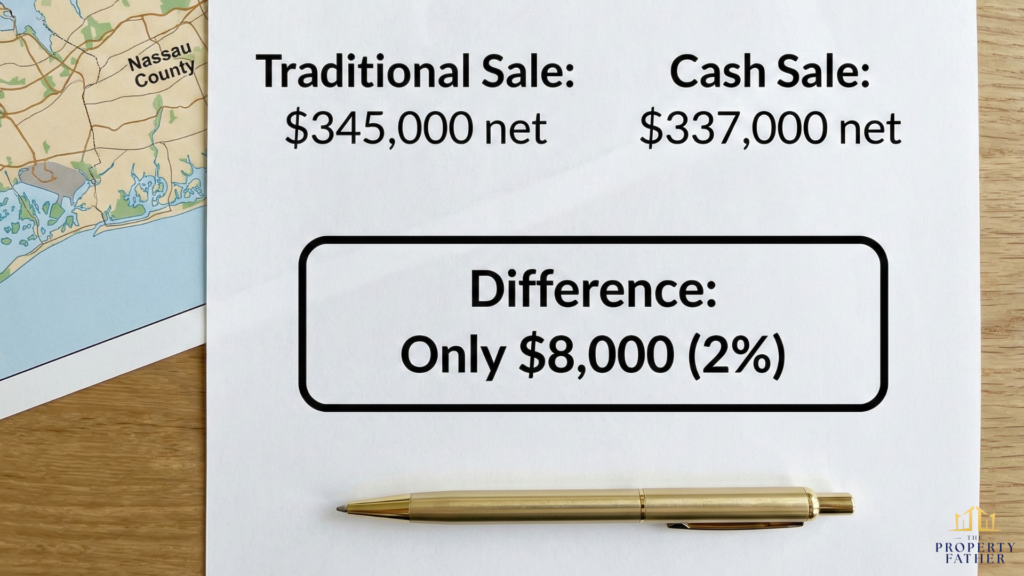
This is where sellers see whether cash home buyers pay fair price in practice. Let’s look at an illustrative example based on a Nassau County home with an assessed market value of $400,000:
Advisory Note: The figures below are illustrative examples based on a hypothetical Nassau County property at $400,000. Actual net proceeds depend on your property’s specific value, outstanding liens, negotiated commission terms, local market conditions, and individual closing costs. These are not guaranteed outcomes. Consult with a licensed real estate attorney and CPA before making decisions based on any projected net proceeds figures.
Traditional Sale (Illustrative):
- Sale Price: $400,000
- Agent Commission (5% — illustrative estimate; rates are negotiable): –$20,000
- Closing Costs (3%): –$12,000
- Buyer-Requested Repairs: –$8,000
- Carrying Costs During 5-Month Sale (mortgage, taxes, utilities): –$15,000
- Net Proceeds: ~$345,000
- Timeline: 5 months
Cash Sale (Illustrative):
- Cash Offer: $340,000
- Closing Costs: $0 (buyer paid)
- Repairs: $0 (as-is sale)
- Carrying Costs: –$3,000 (closed in 14 days)
- Net Proceeds: ~$337,000
- Timeline: 14 days
The difference in this example? About $8,000 — roughly 2% of the home’s value. For a seller facing foreclosure, dealing with an inherited property, or going through a contentious divorce, that $8,000 gap meant getting $337,000 in two weeks instead of maybe getting $345,000 in five months — if everything went perfectly. Many sellers find that whether selling for cash is worth it depends entirely on their unique circumstances.
Post-Closing: Your Responsibilities Don’t End at Signatures
Tax Implications
The title company or closing agent is generally required to file a Form 1099-S (Proceeds from Real Estate Transactions) and provide you a copy. Do not assume you won’t receive one.
If your gain on the sale is fully excludable under the primary residence rules, you may be able to provide a written certification to the closing agent before closing, which can relieve them of the 1099-S filing requirement. But this depends on your specific circumstances.
Advisory Note: Tax treatment of real estate sale proceeds — including capital gains, cost basis for inherited property, and 1099-S reporting — varies significantly by individual situation. The overview below is general in nature. Consult a licensed CPA or tax attorney before your closing to understand your specific tax obligations. See IRS Topic 701 and IRS Publication 523 for primary residence sale rules.
Most homeowners who lived in the property as their primary residence for at least two of the last five years can exclude up to $250,000 of gain ($500,000 for married couples filing jointly) under IRS rules. For inherited properties, the cost basis is typically stepped up to fair market value on the date of the previous owner’s death, which can significantly reduce or eliminate capital gains tax.
Forwarding Address and Mail
File a change of address with USPS and update your information with banks, insurance companies, and anyone else sending you important mail.
Canceling Insurance
Call your homeowners insurance company and cancel coverage effective the closing date. You’ll receive a prorated refund for any prepaid premiums.
Utility Billing
Expect final utility bills to arrive 4–6 weeks after closing.
When Cash Buyers Don’t Pay Fair Price — Red Flags to Watch For
Not every cash buyer operates ethically. Here’s how to spot the difference:
Warning Sign #1: Pressure to Sign Immediately Legitimate cash buyers give you time to review contracts with an attorney. If someone’s pushing you to sign paperwork on the spot “before the offer expires,” walk away. Before signing anything, have a list of questions to ask a cash buyer ready.
Warning Sign #2: Requesting an Upfront Fee You should never pay a cash buyer to make an offer or process your sale. No “marketing fees,” “administrative costs,” or “due diligence deposits” are legitimate.
Warning Sign #3: No Proof of Funds Before signing a contract, your attorney should verify the buyer can actually close. If they refuse to provide bank statements or a proof of funds letter, they may be trying to wholesale your contract to another investor — which delays your closing and sometimes leads to reduced offers.
Warning Sign #4: Changing the Deal After Contract Signing The price you agree to should be the price you get, minus any liens or debts being paid off. If the buyer comes back days before closing demanding a lower price, walk away or enforce the contract with your attorney.
Warning Sign #5: Vague Contract Terms Your purchase agreement should clearly state the price, closing date, which closing costs each party pays, and what condition the property is being sold in.
Why Long Island Homeowners Choose Cash Sales Despite Lower Offers
Understanding when cash buyers make sense helps answer whether they pay fair price for your specific situation:
Pre-Foreclosure in Suffolk County: When you’re behind on mortgage payments and the foreclosure clock is ticking, time is literally money. Every month of delay adds late fees, legal costs, and credit damage. A cash buyer who closes in two weeks and pays off your mortgage before foreclosure proceedings advance may net you less on paper — but the difference in long-term credit and financial health can far outweigh it.
Inherited Property Nobody Wants to Keep: Three siblings inherit a Long Island home. None live nearby, no one wants to manage renovations, and coordinating decisions across three families is a challenge. A cash offer that requires zero effort, no holding costs, and splits proceeds quickly can be more equitable than spending months arguing about contractors and listing agents.
Divorce in Nassau County: The longer the house sits on the market, the longer you’re tied to your ex-spouse financially and emotionally. A cash sale that closes fast lets both parties move forward.
Property That Needs Major Repairs: If your home needs $40,000+ in repairs you can’t fund, a cash buyer who accepts the property as-is effectively absorbs those costs in the offer.
What “Fair Price” Actually Means in Real Estate
There’s no single “fair price” for any property. Value is relative to the buyer’s situation, the seller’s timeline, and the condition of the property.
A retail buyer — someone planning to live in the home — will pay top dollar but demands move-in readiness, requires mortgage approval, and takes 45–60 days to close. An investor pays less upfront but accepts properties in any condition, closes in weeks, and brings certainty that traditional buyers can’t offer.
Do cash home buyers pay fair price? They pay a fair investor price based on:
- After-Repair Value (ARV): What the property will be worth after renovations
- Repair Costs: What they’ll spend fixing the property
- Holding Costs: Mortgage, taxes, insurance, utilities while they renovate and resell
- Profit Margin: Typically 10–20% to justify the risk and effort
When you understand this formula, the offer makes sense. Cash buyers aren’t trying to steal your house — they’re running a business with real costs and risks. If multiple reputable buyers offer similar amounts, that’s the fair market value for a quick, as-is sale. Understanding why cash offers are lower than retail value helps set realistic expectations.
According to Long Island real estate market data, local market conditions in Nassau and Suffolk counties vary significantly by neighborhood and property type — which is why a locally knowledgeable buyer often produces a more accurate offer than a national iBuyer platform.
Special Situations That Favor Cash Sales
Probate Sales: Time Is Money Probate proceedings in New York can take anywhere from several months for straightforward uncontested estates to 18 months or more for complex or contested cases, depending on the Surrogate’s Court in your county and case specifics under the NY Surrogate’s Court Procedure Act. During that time, the estate pays property taxes, insurance, utilities, and maintenance costs on the inherited property. A cash buyer who can close quickly once the executor receives court approval stops the financial bleeding.
Advisory Note: Probate timelines and legal requirements vary significantly by estate complexity and county. Consult a New York estate attorney before making decisions about selling inherited property.
Job Relocation: Don’t Carry Two Mortgages Relocating for work? A cash sale that closes before you start your new job eliminates the burden of managing a Long Island property remotely and carrying two housing payments.
Tenant-Occupied Properties Selling a rental property with tenants in place is complicated for traditional buyers. Cash investors often purchase tenant-occupied properties, either honoring existing leases or working with tenants to transition them out fairly.properties, either honoring existing leases or working with tenants to transition them out fairly.

Ready to Sell Your Long Island Home Fast?
Whether you’re in Suffolk County dealing with an inherited property, Nassau County handling a divorce sale, or anywhere on Long Island facing foreclosure or simply needing to sell quickly, the answer to “do cash home buyers pay fair price?” comes down to what “fair” means to you. If speed, certainty, and avoiding repairs matter more than squeezing out every last dollar months from now — then yes, a cash offer is fair.
Get a no-obligation cash offer in 24 hours. Close in as little as 7–14 days. Keep more of your equity than you’d expect when you factor in the costs and delays of traditional sales.
Read the complete guide: Selling Your Long Island Home Fast
Questions? Call (516) 548-6558 to speak with our team about your specific situation. For additional insights and real estate tips, follow us on YouTube and Pinterest.
We buy houses throughout Long Island and close on your timeline — whether that’s 7 days or 30 days.